

Blog
Which Socket and Switch Rating for Home Appliances?
A practical 6A, 16A and 32A guide for ACs, geysers, refrigerators, washing machines and kitchen appliances
Updated on Oct 2026
The right socket for an appliance is determined by its rated input current, supplied plug, manufacturer instructions and circuit design—not by the appliance name alone. In a typical Indian home, 6A points suit low-load electronics and small appliances, while many high-load appliances use a correctly rated 16A point. Equipment that draws more current may need a dedicated fixed connection through a suitable double-pole switch or isolator instead of a normal socket.
This distinction matters because an adapter can make a plug fit without making the circuit safe. The socket, switch, cable, earthing and MCB must all be suitable for the load.
If you first need an overview of socket formats, read our guide to electrical socket types in India. This article focuses specifically on choosing a connection for common home appliances.
The Safe Way to Choose a Socket and Switch Rating
Use this order of checks:
- Read the appliance rating label. Note the rated input in watts, amperes and volts.
- Check the supplied plug. Do not replace it or use an adapter simply to fit a lower-rated socket.
- Read the installation manual. Some appliances require a dedicated circuit, double-pole isolation or a fixed connection.
- Have the complete circuit checked. The cable size, MCB, RCCB protection, earthing, switch and outlet must work together.
- Allow for starting current. Motors and compressors can briefly draw more current when they start.
For a simple estimate, current is approximately power divided by voltage:
Current (A) = Power (W) ÷ Supply voltage (V)
A 2,000 W appliance on a 230 V supply draws roughly 8.7 A during normal operation. That calculation is only a starting point. It does not account for motor starting current, installation conditions or the manufacturer's specified protective device.
Quick Appliance Selection Table
| Appliance | Common planning approach | What to verify before installation |
|---|---|---|
| Phone charger, router, table lamp | General-purpose 6A point | Product condition and firm plug contact |
| Television, desktop computer | Earthed general-purpose point, commonly 6A | Combined equipment load and surge protection needs |
| Refrigerator | Dedicated earthed point; rating must match the supplied plug and label | Compressor starting current, earthing and manufacturer instructions |
| Washing machine or dishwasher | Dedicated earthed point, often 16A where specified | Rated input, water-safe location and RCCB protection |
| Microwave, OTG or induction cooktop | Dedicated point selected from the nameplate, commonly 16A for higher-load models | Actual wattage, plug rating and circuit capacity |
| Storage water heater or geyser | Dedicated circuit with correctly rated double-pole control or isolation | Heater wattage, earthing, RCCB protection and bathroom safety requirements |
| Split or window AC | Dedicated circuit with suitable isolation; connection depends on model and capacity | Nameplate current, manufacturer instructions, cable and MCB rating |
| High-load built-in appliance | Purpose-designed dedicated circuit; sometimes a fixed connection | Manufacturer wiring diagram and electrician's load calculation |
The table is a planning aid, not a replacement for the appliance manual or an electrician's assessment.
Which Socket Should a Refrigerator Use?
A refrigerator may consume relatively little power while running, but its compressor needs a brief surge when starting. That is why the correct decision should come from the supplied plug and rating label, not a generic rule that every refrigerator must use the same outlet.
For a reliable refrigerator point:
- Use a dedicated, properly earthed socket
- Avoid sharing the point with a microwave or other high-load appliance
- Do not use a loose multiplug or long-term adapter
- Keep the socket accessible without placing it directly behind a hot compressor area
- Follow the manufacturer’s clearance and installation instructions
If the supplied plug is rated for a 16A outlet, use a correctly wired 16A point. Do not change the plug to make it fit a 6A socket.
Which Socket Should a Washing Machine Use?
Washing machines combine a motor, electronic controls and, in some models, an internal water heater. Their loads therefore vary considerably.
Use a dedicated earthed point that matches the appliance label and plug. Many models require a 16A point, but the manual remains the deciding source. The outlet should also be positioned away from splashes and leaks, with appropriate RCCB protection for the circuit.
Never run a washing machine permanently through an extension board. Vibration, moisture and a sustained load make loose temporary connections especially undesirable.
Which Connection Should an Air Conditioner Use?
An AC should normally be served by a dedicated circuit. The required connection changes with its capacity, efficiency, compressor technology and manufacturer instructions.
A small model may be supplied with a plug intended for a correctly rated outlet. A larger model may require a fixed connection through a suitably rated double-pole switch and enclosure or isolator. In either case, the electrician should coordinate:
- The AC nameplate current
- Cable size and route
- MCB rating and trip characteristics
- Earthing
- Isolation near the appliance where required
Do not assume that every AC uses the same 16A socket, and never connect one to a 6A outlet using an adapter.
Which Switch Is Suitable for a Geyser?
Storage water heaters are sustained heating loads and operate in or near wet areas. They need a dedicated circuit, reliable earthing and suitable leakage protection.
Depending on the heater's rated input, the design may use a 16A or higher-rated double-pole control device. A 20A or 32A marking commonly refers to the switch or isolator's switching capacity; it does not mean that a normal household socket is automatically rated for the same current.
The final arrangement should follow the heater manual and be installed by a qualified electrician. The circuit should include correctly selected MCB protection and RCCB protection.
Which Socket Is Suitable for a Microwave, OTG or Induction Cooktop?
Kitchen appliances vary from a few hundred watts to more than 2,000 W. Check every appliance individually.
Higher-load microwaves, OTGs and induction cooktops commonly require a dedicated 16A point. Low-power equipment may use a general-purpose outlet if its label and plug allow it. Avoid operating several heating appliances through one extension board or combined adapter.
When planning a kitchen:
- Provide separate points for appliances that may run simultaneously
- Keep outlets away from sinks and direct heat
- Leave enough space for plugs without sharply bending cables
- Confirm the total kitchen circuit load before installation
6A vs 16A Socket: What Changes?
A 16A socket is designed for a higher current than a 6A socket. It also uses a physically different plug arrangement to discourage accidental connection to an underrated outlet.
| Feature | 6A point | 16A point |
|---|---|---|
| Typical role | General lighting, electronics and smaller loads | Higher-load appliances where specified |
| Plug size | Smaller round-pin format | Larger round-pin format |
| Circuit planning | May serve several suitable general-purpose points | Often placed on a dedicated circuit for a specific appliance |
| Safe selection | Match the connected load and supplied plug | Match the load, wiring and protective device—not just the outlet face |
Indian Standard IS 1293:2019 covers household plugs and socket-outlets rated up to 250 V and 16 A. For loads or connection arrangements beyond an ordinary 16A socket, the solution should be designed specifically rather than improvised.
What Does a 20A or 32A DP Switch Mean?
DP means double pole. A DP switch or isolator disconnects both the live and neutral conductors together. It is commonly used to control or isolate loads such as water heaters, air conditioners and other dedicated equipment.
The printed current rating is the capacity of that switching device under its specified conditions. Safe operation still depends on the entire circuit:
- The connected appliance load
- Cable current-carrying capacity
- MCB and RCCB selection
- Terminal quality and tightening
- Enclosure and installation conditions
Installing a 32A DP switch does not increase the capacity of undersized wiring or a 16A socket.
Why Adapters Do Not Solve a Rating Mismatch
An adapter changes pin compatibility. It does not upgrade:
- The socket contacts
- Concealed wiring
- Switch rating
- Earthing
- Circuit protection
If a heavy appliance plug does not fit the available outlet, treat that as a warning to check the installation. Do not make it fit by force or leave it connected through a travel adapter.
Warning Signs That an Appliance Point Is Unsafe
Stop using the point and call a qualified electrician if you notice:
- A plug or socket becoming hot
- Browning, melting or a burning smell
- Buzzing, crackling or sparking
- A plug that sits loosely in the socket
- Repeated MCB or RCCB tripping
- An adapter or extension board being used permanently
These symptoms need diagnosis. Replacing only the visible socket may not correct damaged wiring or an unsuitable circuit.
Planning Appliance Points During Construction or Renovation
Create an appliance schedule before electrical boxes and conduits are finalized. Record the intended AC, geyser, refrigerator, washing machine, dishwasher, microwave, oven and induction-cooktop locations. Then give each item:
- The connection type stated by its manufacturer
- A suitable dedicated circuit where required
- Accessible isolation
- Proper earthing and leakage protection
- A practical mounting position
Our switchboard height guide can help with placement, while the electrical overload guide explains why several large loads should not be concentrated on one point.
Final Recommendation
Do not choose a socket by memorizing that one appliance always uses 6A and another always uses 16A. Start with the nameplate, supplied plug and manual, then have the circuit checked as a complete system.
For new projects, compare Cube modular switches and sockets, DP switch and enclosure options, and MCB circuit protection. A qualified electrician should make the final selection for the actual appliance, cable route and installation conditions.
Related Electrical Planning Guides
Frequently Asked Questions
Should a refrigerator use a 6A or 16A socket?
Use the socket specified on the refrigerator's rating label and plug. Many refrigerators have a modest running load but their compressors draw a brief starting current. A dedicated, properly earthed point is more important than choosing from the appliance name alone. Do not replace the supplied plug or use a loose adapter to force a mismatch.
Can an air conditioner run from a normal 6A socket?
An air conditioner should normally have a dedicated circuit and a correctly rated connection selected from its nameplate current and manufacturer instructions. A standard 6A socket should not be used merely because an adapter makes the plug fit. Larger ACs may require an isolator or fixed connection rather than an ordinary household socket.
What is the difference between a 16A socket and a 32A DP switch?
A 16A socket is a plug-in connection rated to carry up to its specified current. A 32A double-pole switch or isolator is a control and isolation device that disconnects both live and neutral conductors. A 32A marking on the switch does not turn the connected socket into a 32A socket. The complete circuit must be designed as one system.
Can I use an adapter to connect a heavy appliance to a 6A socket?
No. An adapter changes the physical fit, not the current-carrying capacity of the socket, wiring or protective device. Heavy appliances should use the connection and dedicated circuit specified by the manufacturer and a qualified electrician.
Recommended next steps
Plan a safer electrical system
Use the guide above to plan the installation, then compare the relevant products for your project.
Cube Switches & Sockets
Compare modular socket and switch options for everyday and higher-load appliance points.
Explore products →DP Switch & Enclosure
Dedicated double-pole control and isolation for suitable high-load applications.
Explore products →MCB Circuit Protection
Coordinate appliance circuits with correctly selected overload and short-circuit protection.
Explore products →Need Help Choosing the Right Electrical Products?
Get instant expert guidance via WhatsApp
You May Also Like
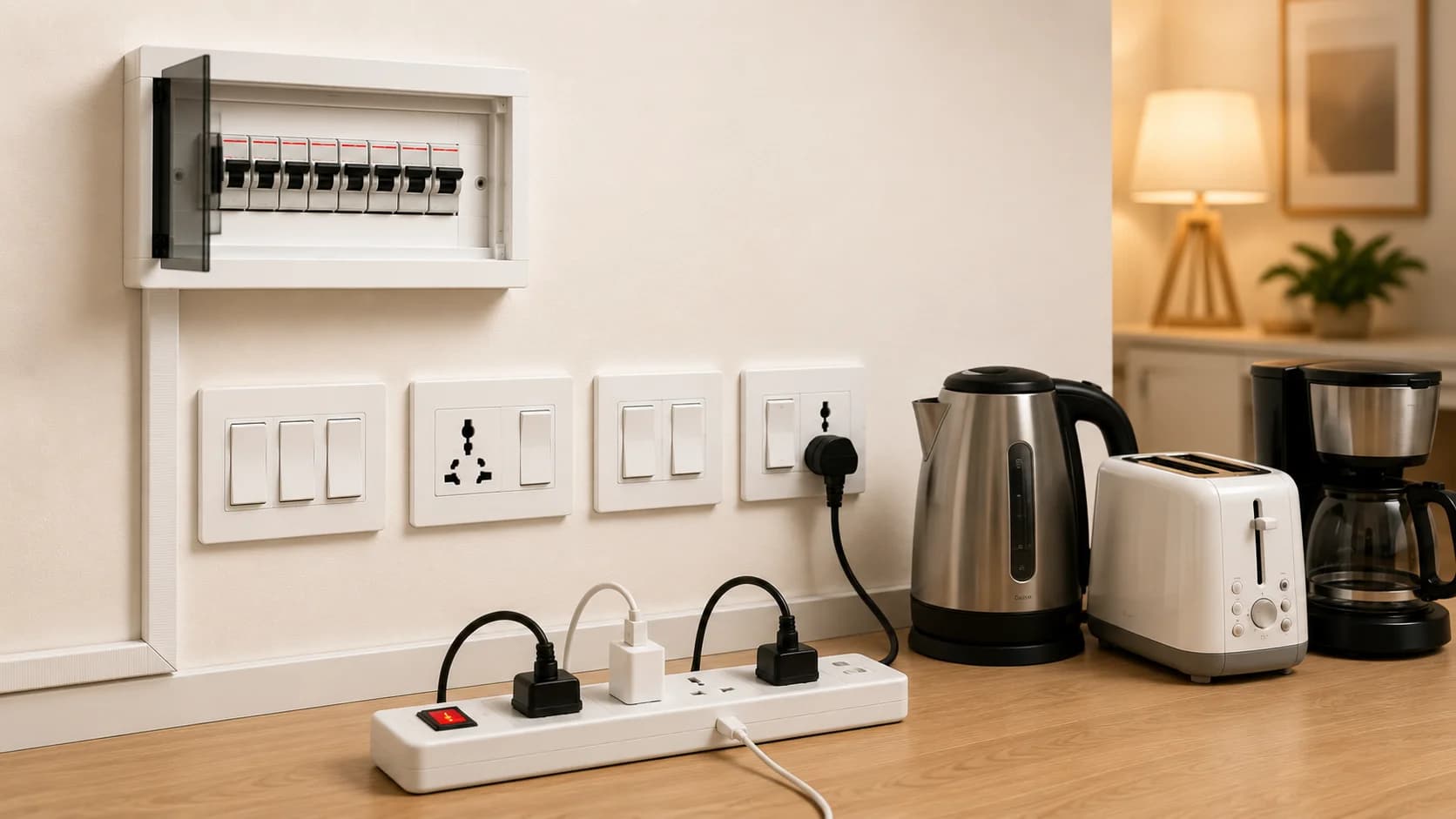
Standard Switch Board Heights in Indian Homes: Complete Installation Guide
See standard switchboard heights from the floor in feet and metres for bedrooms, kitchens, bathrooms, ACs, geysers and other points in Indian homes.
Read More →
Comparing Gold Coast Switches: Luxe vs. Cube vs. Mia Series
Which Gold Coast modular switch range is right for you? Compare Luxe, Cube, and Mia series design, materials, pricing, and suitability.
Read More →
How to Prevent Electrical Overload at Home: 8 Practical Steps
Learn how to prevent electrical overloading at home with correct socket ratings, dedicated circuits, MCB protection and eight practical safety steps.
Read More →